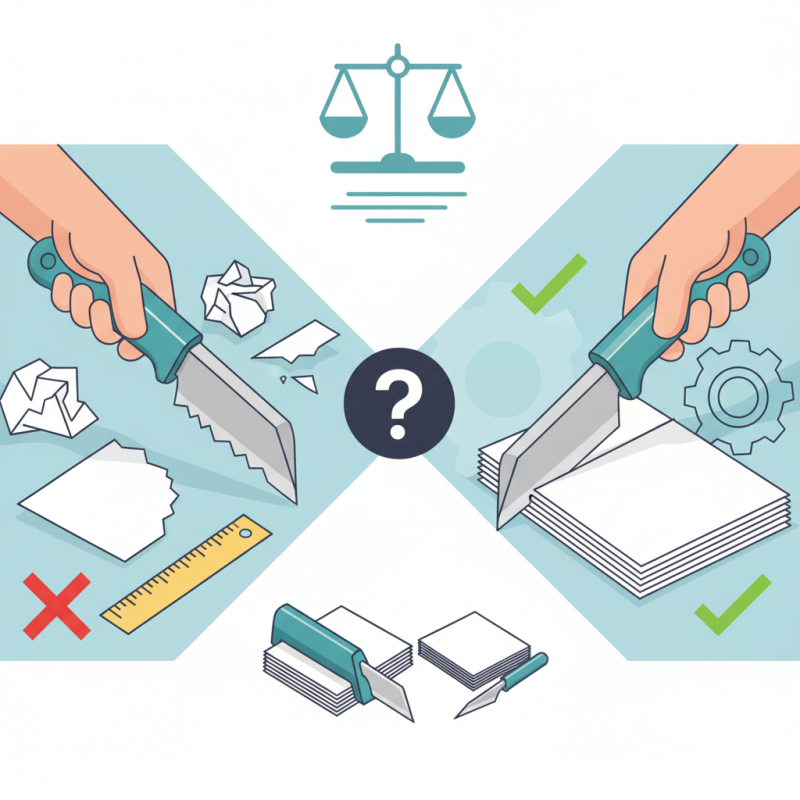
Selecting the appropriate Paper Cutter Knife can significantly impact your crafting or business processes. Industry expert John Stevens, who has over 15 years of experience, emphasizes, "The right knife makes cutting safer and cleaner." Choosing a knife tailored to your specific needs ensures precision and efficiency in your projects.
Quality matters when it comes to a Paper Cutter Knife. A blade that feels comfortable will enhance your cutting accuracy. However, not every knife suits every user. It's crucial to consider factors like thickness and material type. For instance, a thicker blade can efficiently cut through multiple sheets but may lack control for delicate projects.
Reflecting on personal experiences, many users find that their initial choice led to frustration. A dull or incorrect knife can ruin a project and waste materials. The right Paper Cutter Knife can elevate not just the end product but also your confidence in the cutting process. Therefore, taking time to choose wisely is essential.
Understanding the Different Types of Paper Cutter Knives Available
When selecting a paper cutter knife, understanding the available types is crucial. There are rotary cutters, guillotine cutters, and straight blade cutters. Each type serves different needs and offers unique benefits. Rotary cutters feature a circular blade, making them ideal for cutting multiple sheets smoothly. They are often used in craft projects. Guillotine cutters are excellent for precise, straight cuts, ideal for larger volumes of paper. Their lever-style operation helps reduce user fatigue.
Straight blade cutters offer versatility in design. They are available for both manual and electric use. The manual options are often lighter and easier to use for small tasks. Electric models, however, can handle larger jobs with speed and precision. There is a certain learning curve associated with these knives. Users might struggle with maintaining a straight line initially. This aspect also raises safety concerns that a new user must acknowledge.
Material quality is another factor to consider. Various blades can be made from high-carbon steel, stainless steel, or even plastic composites. Each material affects durability, sharpness, and maintenance requirements. Therefore, it is essential to evaluate how often you will be using the cutter. Users should reflect on their specific needs. Choosing the right knife can significantly impact workflow and efficiency.
Why Choose the Right Paper Cutter Knife for Your Needs?
Evaluating Your Specific Cutting Needs and Requirements
When choosing a paper cutter knife, assessing your specific cutting needs is vital. Different projects require varying blade types and sizes. For instance, heavy-duty materials need sharper, robust blades. Lightweight paper, on the other hand, may only require a basic cutter. This awareness can improve your efficiency and output quality.
Consider the volume of cutting you do. Do you handle multiple sheets at once? If yes, a guillotine cutter may be suitable. If your work is more intricate, a precision knife might be ideal. Think about the level of detail you need. Some projects may not allow for mistakes, while others can. Acknowledging the trade-offs can guide your selection process.
It’s also important to reflect on safety features. A reliable cutter should minimize accidents. However, overconfidence can lead to mishaps. Double-check the blade sharpness and safety guards. Always prioritize a tool that fits well in your hand. Finding balance between comfort and safety can enhance your cutting experience.
Key Features to Look for in a Quality Paper Cutter Knife
When selecting a paper cutter knife, understanding key features is essential.
Sharpening quality is paramount.
A well-maintained blade can last over 500 cuts, reducing downtime.
Studies show that dull blades can lead to uneven edges and wasting paper.
Users often overlook the dimension of the cutting head. A blade width between 0.5 to 1 inch typically offers greater control.
Precision can make a significant difference in professional settings.
Consider the handle design as well.
Ergonomic handles reduce strain during prolonged use. A study conducted by Ergonomics International noted that users reported a
30% decrease in discomfort with well-designed grips.
Weight balance also plays a role. A knife that feels balanced instills user confidence and prevents accidents.
However, meticulous checking of blade maintenance and replacement schedules often gets neglected,
leading to unsafe working environments.
Another feature to explore is safety mechanisms.
Models with retractable blades minimize the risk of accidental cuts.
Data from the American Safety Council reveals that
improperly handled cutters account for 25% of workplace injuries.
Often, choosing a knife with built-in safety features goes overlooked, prompting a need for greater awareness.
Balancing safety, functionality, and ease of use is crucial for long-term satisfaction.
Safety Considerations When Using Paper Cutter Knives
Safety is paramount when using paper cutter knives. According to the American National Standards Institute (ANSI), over 15,000 injuries related to paper cutting equipment occur annually in the United States alone. This statistic highlights the importance of selecting the right knife for your needs, as well as implementing proper safety measures.
Understanding the features of a paper cutter knife can significantly reduce the risk of accidents. A well-designed handle provides better grip, minimizing the chances of slippage during use. Furthermore, ensuring the blade is sharp improves cutting efficiency, reducing the force required and thus lowering the likelihood of mistakes. Inadequate training and poor work environments often contribute to accidents, indicating a need for comprehensive education on safe practices.
Additionally, incorporating safety guards and personal protective equipment (PPE) can minimize potential injuries. Yet, many users overlook these essentials. Regular maintenance is also vital. Dull blades not only pose hazards but can lead to frustration, often resulting in improper use. Elevating awareness about safe usage practices is crucial; it can save lives and prevent serious injuries.
Maintenance Tips for Ensuring Longevity of Your Paper Cutter Knife
Proper maintenance of your paper cutter knife is essential for its longevity and effectiveness. A well-maintained knife ensures clean cuts and increases your productivity. Regularly check the blade for dullness. A dull blade requires more force and can lead to accidents. If it starts to resist cutting, it’s time to sharpen or replace.
Cleaning is another critical aspect. Dust and debris can accumulate on the blade, affecting its performance. Wipe the blade with a soft, dry cloth after each use. If sticky residue appears, use a mild detergent. Avoid harsh chemicals; they can damage the blade finish.
Tips for proper maintenance include storing the knife in a protective case. This prevents accidental damage and keeps the blade sharper longer. Also, inspect the alignment regularly. Misalignment can lead to jagged edges and uneven cuts.
Address these issues promptly to avoid larger problems down the line. Taking these small steps can greatly enhance the reliability of your paper cutter knife.
FAQS
: A sharp blade can handle over 500 cuts, reducing downtime and improving cutting efficiency.
A cutting head width between 0.5 to 1 inch offers better control, especially in professional settings.
They reduce strain during use, with users reporting a 30% decrease in discomfort when using well-designed grips.
Models with retractable blades are safer and help prevent accidental cuts during use.
Regular checks on blade sharpness prevent accidents caused by dull blades, improving safety and cutting efficiency.
Clean the blade after each use, store it in a protective case, and check for alignment regularly.
A balanced knife boosts user confidence and minimizes the risk of accidents during cutting.
Without proper education on safe practices, accidents may increase due to misuse of paper cutter knives.
Cleaning prevents debris buildup that affects performance, ensuring cleaner cuts with less effort required.
Raising awareness about safety tools and maintenance can significantly reduce injury risks in the workplace.
Conclusion
Choosing the right Paper Cutter Knife is essential for ensuring precision and efficiency in your cutting tasks. There are various types of paper cutter knives available, each designed for specific cutting needs, whether you are handling large volumes of paper or requiring intricate designs. It is crucial to evaluate your specific requirements to select a knife that aligns with the scale and complexity of your projects.
When selecting a Paper Cutter Knife, consider key features such as blade material, cutting capacity, and ergonomic design, which can significantly impact usability and performance. Safety should also be a priority; always follow recommended practices to prevent accidents while using these tools. Additionally, regular maintenance is vital to prolonging the lifespan of your knife, including proper cleaning and sharpening techniques to keep it in optimal condition. By following these guidelines, you can ensure you have the right Paper Cutter Knife for your needs, enhancing both safety and effectiveness in your work.

 Shen Gong Carbide